
To keep a 12V fridge running reliably on the road, you need a battery capacity that covers its daily energy draw plus some extra for efficiency and future needs. For example, if your fridge uses 50W for 8 hours daily, you’ll need about 400Wh. Taking into account lead-acid batteries only discharge 50%, you should aim for around 800Wh. Lithium batteries can provide more usable capacity with less buffer. If you’re curious about sizing it perfectly, there’s more to consider.

Get travel and outdoor gear delivered free with Prime
- Fast, free delivery on millions of items
- Prime Video, Amazon Music and more included
- Member-only deals all year
Key Takeaways
- Determine the fridge’s power consumption in watts and estimate daily running hours to calculate daily energy needs in watt-hours.
- Double the daily watt-hour estimate to account for inefficiencies and future power requirements for safety.
- Choose a battery capacity at least twice the daily energy need, considering whether using lead-acid or lithium batteries.
- Factor in solar panel input to recharge batteries during the day, reducing overall battery size needed.
- Select batteries with appropriate capacity and management practices to ensure longevity and reliable power for your road trip.
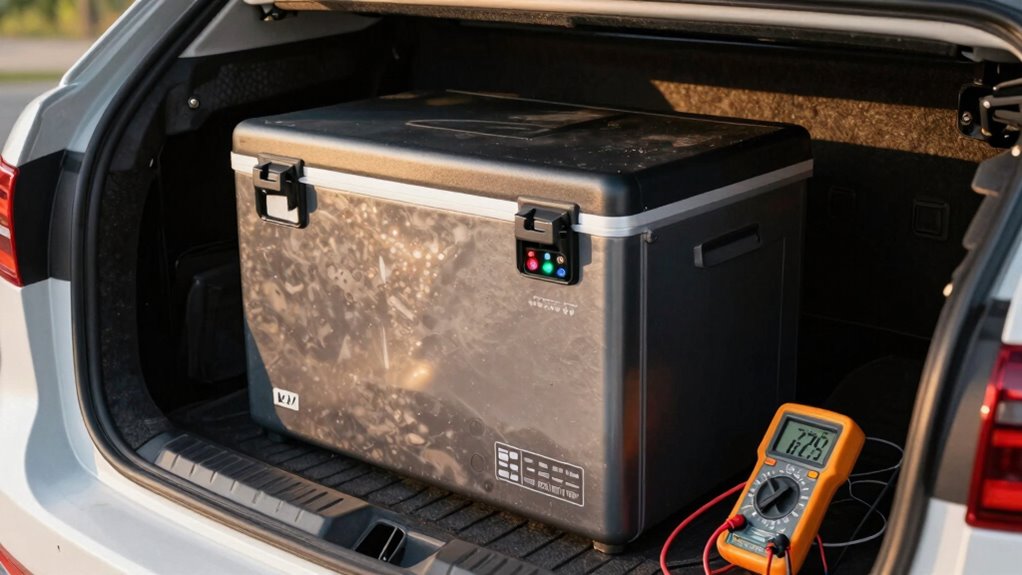
If you’re wondering how much battery capacity you need to run a 12V fridge, understanding your fridge’s power consumption is essential. Every fridge has a different energy draw, usually listed in watts or amps on the label. To determine your needs, start by noting how many hours per day you’ll run the fridge. For example, if your fridge consumes about 50 watts and runs roughly 8 hours daily, you’ll need to calculate the total energy consumption in watt-hours. Multiply 50 watts by 8 hours, which equals 400 watt-hours. This gives you a baseline to work from when sizing your battery bank.
Calculate your fridge’s daily watt-hours to determine the right battery capacity.
When choosing batteries, consider the role of solar energy in your setup. Solar panels can recharge your batteries during the day, making your power supply more sustainable and reducing reliance on grid electricity. This integration not only boosts your power efficiency but also extends your system’s independence, especially if you’re off-grid or camping for extended periods. Keep in mind that the size and number of solar panels you need depend on your daily energy consumption and the sunlight hours in your location. Additionally, understanding the importance of energy efficiency can help you optimize your system and reduce overall power needs.
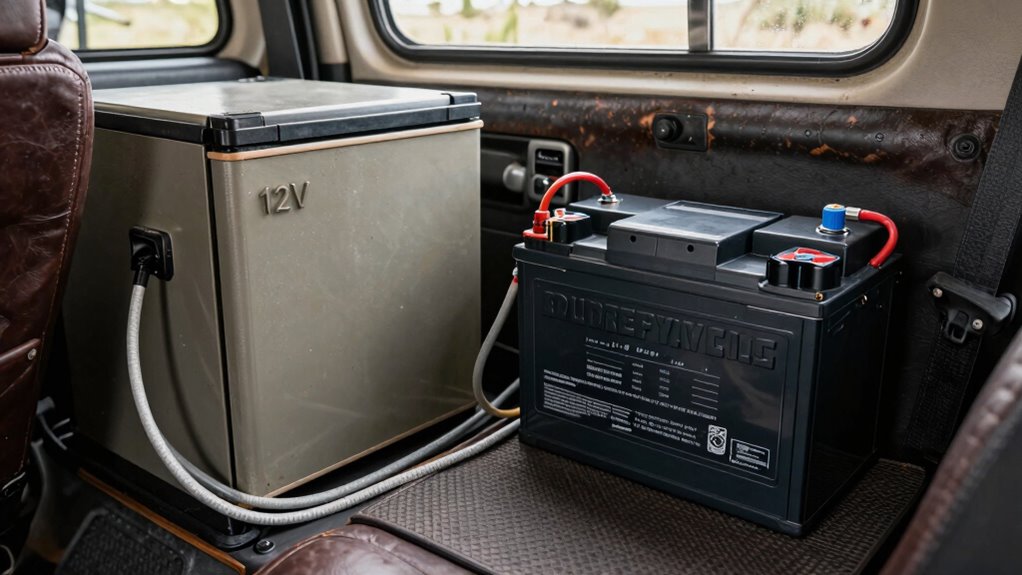
Once you know your daily watt-hour requirement, you can determine the battery capacity. For example, to cover 400 watt-hours daily, you’ll want a battery bank with a capacity that provides some margin for inefficiencies and future needs. A good rule of thumb is to double that number, so aiming for around 800 watt-hours or more ensures you won’t run out of power. If you’re using a deep-cycle lead-acid battery, remember that they should only be discharged about 50% to prolong their life. This means you’ll need a battery capacity of around 1,600 watt-hours to safely meet your needs. Lithium batteries, however, can often be discharged further, offering more usable capacity in a smaller size. It’s also important to consider the battery’s cycle life to ensure your investment lasts over time. Employing proper battery management practices can significantly enhance your system’s longevity and performance. By carefully calculating your fridge’s energy needs, leveraging solar energy, and selecting batteries with appropriate capacity and efficiency, you’ll be well on your way to a reliable, off-grid power setup for your 12V fridge.
12V deep cycle battery for RV fridge
As an affiliate, we earn on qualifying purchases.
As an affiliate, we earn on qualifying purchases.
Frequently Asked Questions
Can Solar Panels Adequately Charge a 12V Fridge Battery?
Yes, solar panels can adequately charge a 12V fridge battery if you choose panels with high solar panel efficiency. To guarantee reliable power, you need to monitor your battery’s charge level regularly and perform proper battery maintenance. Keep your panels clean and positioned for maximum sun exposure. This way, solar energy can maintain your fridge’s battery charge, especially during long trips or overcast days.
How Does Ambient Temperature Affect Battery Life?
Sure, ambient temperature’s a real game-changer. When temperatures fluctuate wildly, your battery’s life takes a hit — it’s like giving it a rollercoaster ride. Higher temps accelerate battery degradation, shortening its lifespan, while cold temps can reduce capacity temporarily. So, if you’re counting on your battery on the road, keep it cool and steady. Mother Nature’s little irony: the more unpredictable, the faster your battery wears out.
What Is the Ideal Battery Type for a 12V Fridge?
You should choose a deep cycle AGM or Lithium-ion battery for your 12V fridge. These batteries offer better battery lifespan and power efficiency, making them reliable for extended use on the road. AGM batteries are more affordable and low-maintenance, while Lithium-ion batteries provide higher energy density and longer lifespan, ensuring your fridge stays powered longer without frequent recharging. Pick based on your budget and power needs.
How Long Can a Battery Run a Fridge Without Recharging?
Did you know a typical 12V fridge consumes about 1-2 amps per hour? Without recharging, a well-maintained, high-quality battery can power your fridge for roughly 24-48 hours, depending on its size and efficiency. Proper battery maintenance and choosing a power-efficient fridge extend this time. Always monitor your battery’s health and conserve power to guarantee your fridge keeps running longer without recharging.
Does Battery Capacity Vary With Different Fridge Sizes?
Yes, battery capacity varies with different fridge sizes. Larger fridges consume more power, so they require higher battery capacity to operate efficiently. Smaller fridges use less energy, meaning you can get away with a smaller battery. When choosing a battery, consider your fridge size and energy needs. Always opt for a capacity that comfortably covers your usage, so you avoid running out of power during your trip.
solar panel for 12V camper fridge
As an affiliate, we earn on qualifying purchases.
As an affiliate, we earn on qualifying purchases.
Conclusion
So, while you might think a massive battery is necessary to run your 12V fridge on the road, the truth is, it’s often overkill. With smart energy management and efficient usage, you can get by with a smaller, more manageable battery. Trust me, it’s a myth that bigger always means better here. Focus on your actual needs and a good quality, deep-cycle battery, and you’ll stay chilled without lugging around extra weight.
lithium battery for portable fridge
As an affiliate, we earn on qualifying purchases.
As an affiliate, we earn on qualifying purchases.
As an affiliate, we earn on qualifying purchases.
Fall Picks
fall essentials
As an affiliate, we earn on qualifying purchases.