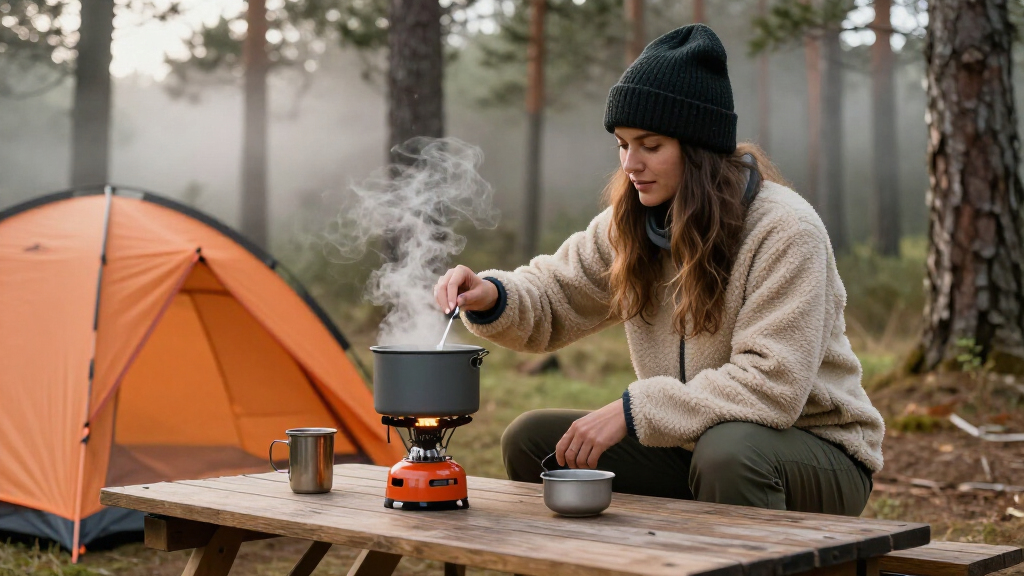
Almost every camper weighing portable stove options ends up comparing the same two families: pressurized gas canister stoves and liquid fuel (often multi-fuel) stoves. The canister camp includes everything from a $25 screw-top burner like the MSR PocketRocket to integrated systems like the Jetboil Flash, all running on threaded isobutane/propane canisters. The liquid fuel camp is anchored by workhorses like the MSR WhisperLite and Optimus Nova, which burn white gas, and in multi-fuel versions also gasoline, kerosene and diesel.

Get travel and outdoor gear delivered free with Prime
- Fast, free delivery on millions of items
- Prime Video, Amazon Music and more included
- Member-only deals all year

WADEO 7200W Windproof Camping Stove with Piezo Ignition
- ✔ Brand: WADEO
- ✔ Power: 7,200 W
- ✔ Burners: Three brass burners

XtremepowerUS Double-Burner Propane Camping Stove
- ✔ Fuel type: LPG propane
- ✔ Number of burners: 2
- ✔ Total cooking power: 25,516 BTU

Gas One GS-3400P Dual-Fuel Portable Camping Stove
- ✔ Fuel types: Butane or propane
- ✔ Butane cartridge size: 8 oz
- ✔ Propane cylinder size: 16.4 oz
The reason readers compare them is a genuine tension: canister stoves are dramatically easier to live with — screw on, click, cook — but they struggle in freezing temperatures, leave you hunting for specific canister refills in remote areas, and generate recurring fuel waste. Liquid fuel stoves demand priming, pumping and periodic maintenance, but they burn hotter, work in serious cold, and let you carry exactly the fuel you need and refill it almost anywhere on Earth.
The main difference in practice: a canister stove is an appliance you use, while a liquid fuel stove is a small machine you operate. If your trips are mostly three-season camping near places that sell fuel canisters, the canister stove is almost certainly the right call. If you winter camp, travel internationally, or go on long expeditions where resupply is uncertain, the liquid fuel stove earns its extra effort. This guide compares them across the criteria that actually drive the decision.
At a Glance
| Criteria | Canister camping stoves (e.g., MSR PocketRocket, Jetboil Flash) | Liquid fuel / multi-fuel stoves (e.g., MSR WhisperLite, Optimus Polaris) | Winner |
|---|---|---|---|
| Ease of use | Screw on and light — near zero learning curve | Requires priming, pumping and technique | A |
| Weight and packed size | 70–450 g depending on model; canisters add weight | Heavier: 300–500 g plus fuel bottle | A |
| Boil time and output | Fast (2–4 min per liter); integrated systems fastest | Very fast once lit; sustained high output | Tie |
| Cold weather performance | Poor below freezing without tricks or inverted canisters | Excellent — white gas performs at any temperature | B |
| Fuel availability and trip length | Canisters can be hard to find remotely; hard to gauge remaining fuel | Fuel available at gas stations worldwide; carry exactly what you need | B |
| Simmering and cooking control | Basic burners simmer poorly; premium models do it well | Simmering is difficult; best at full-bore boiling | Depends |
| Cost of ownership | Stove cheap, but canisters cost $6–10 each and pile up | Stove expensive ($100–200+) but fuel costs pennies per trip | B |
| Maintenance and reliability | Virtually no maintenance; dead canister is the main failure mode | Needs periodic seals, O-rings and cleaning kits; field-repairable | Depends |
WADEO 7200W Windproof Camping Stove with Piezo Ignition
The WADEO earns our top spot because it solves the problem that sinks most single-burner stoves: limited fuel options. Unlike the XtremepowerUS, which only runs on LPG propane, the WADEO accepts isobutane, butane, and 1 lb propane canisters via the two included adapters. That flexibility matters most on longer trips or in rural areas where you cannot count on a specific canister being in stock.Power is the other headline. At 7,200 watts across three brass burners, the manufacturer claims a one-liter boil in under two minutes — output the Gas One simply cannot match. The integrated windproof aluminum alloy cover gives it a real advantage over both competitors in exposed conditions, since neither the XtremepowerUS nor the Gas One includes any wind protection at all. Compared with the Gas One’s 5.91-inch footprint philosophy, WADEO’s wider cooking surface accepts a broader range of pots and pans without tipping.The tradeoffs are real but manageable. You must keep track of the fuel adapters, and losing one narrows your fuel options until you replace it. More importantly, the windshield must not be sealed tightly during operation, because trapped heat can cause overheating — a quirk that requires a bit of discipline. At just over 20 ounces with a carry case included, though, this stove makes the most sense for campers who want one stove that works everywhere from weekend car camps to longer backcountry-adjacent trips.
Pros:
- Windproof design and high power for faster cooking in exposed conditions
- Compatible with isobutane, butane, and 1 lb propane canisters
- Wide 5.91-inch cooking area fits a range of cookware
- Lightweight at 20.39 oz, with adapters and carry case included
Cons:
- Requires keeping track of compatible fuel adapters
- Windshield cannot be sealed tightly or the stove may overheat
Best for: Campers who want one versatile stove that works across multiple fuel types and trip styles
Not ideal for: Cooking for large groups who need two dishes ready simultaneously
Bottom line: The most balanced pick here — powerful, wind-resistant, and fuel-flexible enough to handle nearly any camping scenario.
“The most balanced pick here — powerful, wind-resistant, and fuel-flexible enough to handle nearly any camping scenario.”
XtremepowerUS Double-Burner Propane Camping Stove
If you have ever tried to cook pasta and heat sauce on a single burner, you already understand the case for this stove. The XtremepowerUS delivers two independently controlled burners with a combined 25,516 BTU, letting you boil water on one side while simmering on the other. Neither the WADEO nor the Gas One can do this — that alone makes it the clear choice for family campouts and base-camp cooking.Where this model differs most from our other picks is footprint. At 27.5 inches wide, it is built for a picnic table, not a backpack. That is not a flaw so much as a design decision: the stainless steel surface wipes clean easily after greasy breakfasts, and the built-in piezo ignition means no fumbling with matches in the dark — a feature all three stoves share, which speaks to how standard push-button lighting has become.The limitations follow from the design. It runs only on LPG propane, so it lacks the WADEO’s fuel flexibility, and it ships without wind protection, meaning gusty sites will slow your cooking noticeably. It is also strictly an outdoor stove, which is common for this category but worth stating plainly. This option stands out for campers who prioritize cooking capacity over packability — and who should skip it entirely if they carry their gear on their back.
Pros:
- Two independently controlled burners for simultaneous dishes
- Built-in piezo ignition requires no matches or lighter
- Portable enough for car camping and outdoor gatherings
- Stainless steel surface wipes clean quickly
Cons:
- Requires propane fuel exclusively
- Bulky compared with single-burner alternatives
- No wind protection included
Best for: Car campers, tailgaters, and families who need two burners at the campsite
Not ideal for: Backpackers or anyone cooking for just one or two people
Bottom line: The only true two-burner option in this lineup, and the right one if cooking volume matters more than weight.
“The only true two-burner option in this lineup, and the right one if cooking volume matters more than weight.”
Gas One GS-3400P Dual-Fuel Portable Camping Stove
The Gas One GS-3400P takes a different approach to fuel flexibility than the WADEO. Rather than adapters, it runs natively on an 8 oz butane cartridge or a 16.4 oz propane cylinder, with the propane converter regulator included in the box. That makes it slightly simpler to operate than the WADEO — no small adapters to misplace — though its total heat output is lower, so expect longer boil times when you are not in a hurry.What sets this model apart from both competitors is its safety engineering. A built-in pressure sensor pairs with a cartridge ejection system and an automatic butane gas flow cutoff, actively protecting against overpressure situations. Neither the WADEO nor the XtremepowerUS offers anything comparable, and for newer campers who feel slightly nervous around compressed fuel, that peace of mind is worth a lot.The compromises are straightforward. It is a single-burner, lower-power stove, so group cooks should look at the XtremepowerUS instead, and fuel is not included — plan on buying a cartridge before your first trip. The adjustable heat dial is precise enough for simmering, which partly compensates for the lower top-end power. Compared with similar entry-level options, this pick makes the most sense for occasional campers, canoe trippers, and anyone who wants a dependable, no-drama stove without a steep learning curve.
Pros:
- Runs on both butane cartridges and propane cylinders
- Automatic piezo-electric ignition with no matches needed
- Adjustable heat dial for precise simmering
- Built-in pressure sensor, cartridge ejection, and gas flow cutoff
Cons:
- Fuel not included with purchase
- Single burner with lower output than higher-powered rivals
- Less suited to windy sites without a separate windshield
Best for: Beginners and occasional campers who want simple operation and strong safety features
Not ideal for: Impatient cooks or large groups needing high output
Bottom line: The safest and simplest stove here — a smart first purchase for casual campers who value reliability over raw power.
“The safest and simplest stove here — a smart first purchase for casual campers who value reliability over raw power.”
As an Amazon Associate we earn from qualifying purchases.
Key Differences
The first big difference is operational. A canister stove works like a kitchen appliance: attach the burner, open the valve, light it, adjust the flame. A liquid fuel stove is a small pressurized system — you pump the bottle, prime the burner with a small flame to vaporize the fuel, then cook. Priming takes practice, and a bad prime produces flaring and soot. For a weekend camper, this learning curve is a real cost; for a committed user, it becomes second nature in a few trips.
The second difference is fuel logistics, and it cuts both ways. Canisters are sealed, spill-proof and available in most outdoor shops and many supermarkets in developed countries — but you cannot fly with them, you cannot refill them, and gauging remaining fuel means shaking the canister or weighing it. Liquid fuel comes in refillable bottles you can carry empty on a plane and fill with white gas, or in a pinch with automobile gasoline in multi-fuel models. On a two-week trip far from an outdoor retailer, this flexibility is decisive; on a car-camping weekend near a gear shop, it is irrelevant.
The third difference is environment. Below roughly -5°C (20°F), the propane in canister fuel stops vaporizing properly, and output drops badly — workaround tricks like keeping the canister warm in your sleeping bag or using inverted-remote systems help but add hassle. White gas burns identically whether it is 20°C or -30°C, which is why liquid fuel stoves have dominated mountaineering and polar expeditions for decades. Against that, liquid fuel stoves are poor at simmering: they want to run hot, and frying an egg gently takes real skill, whereas many canister burners simmer beautifully.
Detailed Comparison
Ease of use (Canister camping stoves (e.g., MSR PocketRocket, Jetboil Flash) wins — major)
Canister stoves require no instruction: thread the burner on, open the valve, ignite. Liquid fuel stoves require priming — heating the generator tube so fuel vaporizes — plus pumping to maintain pressure. Beginners regularly experience flaring, sooty pots and frustration with liquid fuel for the first few uses. For a casual camper, this is a major gap that no amount of spec-sheet reading changes.
Weight and packed size (Canister camping stoves (e.g., MSR PocketRocket, Jetboil Flash) wins — moderate)
A basic canister burner weighs 70–100 g; an integrated system runs 350–450 g. Liquid fuel stoves sit at 300–500 g plus a fuel bottle (100–200 g empty). For short trips, canister systems often win overall because a small 110 g canister covers a weekend. On longer trips, the math shifts: liquid fuel packs more energy per gram once you pass roughly 4–5 days of cooking, and you can decant exactly what you need. For typical 1–3 night trips, the gap favors canisters; it is moderate either way.
Boil time and output (minor difference)
Both families boil water quickly. Integrated canister systems like the Jetboil Flash boil a liter in around 3 minutes thanks to the heat exchanger pot; a bare PocketRocket takes 3.5–4 minutes in calm conditions but loses badly to wind without a windshield. A WhisperLite boils a liter in roughly 3.5–4 minutes and sustains high output far longer — important when melting snow for water, where canisters can empty fast. In normal use this is close to a tie; the differences only matter in wind (liquid fuel with a proper windshield) or snow-melting volumes (liquid fuel pulls ahead).
Cold weather performance (Liquid fuel / multi-fuel stoves (e.g., MSR WhisperLite, Optimus Polaris) wins — major)
This is liquid fuel’s home turf. Canister blends lose pressure as temperatures approach freezing, and output collapses. Workarounds — warming the canister, sleeping with it, or buying inverted remote-canister stoves — partially solve the problem but add complexity. White gas burns at full power at any temperature a human will camp in. If you camp below freezing regularly, this single criterion justifies the liquid fuel stove. The gap is major.
Fuel availability and trip length (Liquid fuel / multi-fuel stoves (e.g., MSR WhisperLite, Optimus Polaris) wins — major)
Canister fuel is easy to buy in North America, Europe, Japan and Australia, but nearly impossible to find in much of South America, Africa and Asia — and you cannot fly with full canisters. Liquid fuel stoves, especially multi-fuel versions, run on white gas, unleaded gasoline or kerosene, all available at filling stations worldwide. On expeditions and international travel, there is no contest. On regional weekend trips, canisters from any gear shop are equally convenient. Gap is major for remote travel, minor otherwise.
Simmering and cooking control (Canister camping stoves (e.g., MSR PocketRocket, Jetboil Flash) wins — moderate)
Basic canister burners adjust smoothly from full blast to a gentle flame, making them far better for real cooking — pancakes, sauces, rice. Liquid fuel stoves have a narrow usable range: throttle them too low and the flame sputters and dies. Some premium canister and remote-canister stoves are genuine backcountry kitchen tools. If you boil water for freeze-dried meals only, ignore this criterion; if you actually cook, it matters. Gap is moderate.
Cost of ownership (Liquid fuel / multi-fuel stoves (e.g., MSR WhisperLite, Optimus Polaris) wins — moderate)
Entry canister stoves cost $25–60; integrated systems $100–170; liquid fuel stoves $100–230. But fuel economics reverse the picture: a $8 canister holds roughly 2–3 hours of burn time, while a liter of white gas costs a few dollars and runs a WhisperLite for similar or longer. Heavy users break even on the stove premium within one or two seasons. For occasional users, the cheap canister stove remains the better deal. Gap is moderate and depends entirely on usage frequency.
Maintenance and reliability (moderate difference)
Canister stoves are close to maintenance-free; the realistic failure is a dead canister with no spare, and you cannot fix a canister in the field. Liquid fuel stoves need occasional O-rings, pump cups and generator cleaning — but every part is field-serviceable with the included toolkit, which is why guides trust them on month-long trips. Reliability philosophy differs: canisters are simple but disposable; liquid fuel is complex but repairable. This genuinely depends on your tolerance for tinkering versus your distance from a gear shop.
Canister camping stoves (e.g., MSR PocketRocket, Jetboil Flash): Pros and Cons
Pros:
- Nearly zero learning curve — cooking within a minute of opening the box
- Lightest complete systems for short trips (burners from 70 g)
- Excellent flame control for real cooking on most models
- No priming, pumping, spilling or fuel smell on hands
- Integrated systems (Jetboil) offer the fastest, most wind-resistant boil-and-eat workflow
Cons:
- Performance collapses in freezing temperatures
- Cannot fly with canisters or refill them; empty canisters are waste
- Hard to gauge remaining fuel mid-trip
- Canister availability varies by country; specific threaded canisters may be unavailable
- Recurring fuel cost adds up for frequent users
Liquid fuel / multi-fuel stoves (e.g., MSR WhisperLite, Optimus Polaris): Pros and Cons
Pros:
- Full performance at any temperature, including deep winter
- Fuel available worldwide at gas stations; multi-fuel models run on gasoline and kerosene
- Cheapest fuel per burn-hour by a wide margin over time
- Carry exactly the fuel you need; refillable bottles fly empty
- Field-repairable with included tools — expedition-proven reliability
Cons:
- Requires priming, pumping and a real learning curve
- Poor simmering; best for boiling, not delicate cooking
- Heavier complete kit for short trips
- Regular maintenance: seals, pump cups, generator cleaning
- Occasional flaring and sooty pots, especially with auto fuel
Who Should Choose What
Choose Canister camping stoves (e.g., MSR PocketRocket, Jetboil Flash) if:
- You camp three seasons in regions where canister fuel is stocked
- You want the lightest, simplest kit for weekend backpacking or bikepacking
- You actually cook meals, not just boil water, and need flame control
- You’re new to camping and want zero fiddling on your first trips
Choose Liquid fuel / multi-fuel stoves (e.g., MSR WhisperLite, Optimus Polaris) if:
- You camp in freezing or sub-zero conditions, or melt snow for water
- You take long trips (a week or more) where resupply is uncertain
- You travel internationally to regions without canister availability
- You cook frequently enough that canister costs have become annoying
Skip both if: You only car camp at developed sites with fire grills and picnic tables — a cheap dual-burner propane stove serves you better than either backpacking option. Likewise, if you camp almost never, borrow before buying.
Value for Money
The value question here is not sticker price but usage pattern. A $30 canister burner is the best value in camping for anyone doing a handful of trips a year: it costs less than two canisters of fuel wasted on the learning curve of a liquid fuel stove. Even the $150 integrated systems justify themselves for frequent boil-only users through speed and fuel efficiency.
The $150–230 liquid fuel stove is the opposite proposition: a high upfront cost that only pays back through intensity of use. Burn enough hours — regular winter camping, long expeditions, or simply dozens of trips per year — and the pennies-per-hour fuel economics overtake canister costs within one to two seasons. The premium is also buying capability, not just savings: cold-weather power and worldwide fuel access are things no canister stove can offer at any price.
Paying more is worth it only if you will use the extra capability. A WhisperLite used twice a summer is a worse value than a PocketRocket used every weekend — but a PocketRocket on a winter expedition isn’t merely poor value, it’s a safety liability.
Final Verdict
For the majority of campers — three-season users on trips of a few days in canister-friendly regions — the canister stove is the clear choice. It is lighter, simpler, better at actual cooking, and starts working the moment it leaves the box. If you boil water for rehydrated meals, an integrated canister system is the fastest, most efficient version of that workflow; if you cook real food or count grams, a quality screw-top burner with a windshield is the better fit.
Choose the liquid fuel stove if freezing temperatures, long expeditions or international travel are part of your actual plans, not hypothetical ones. Its cold-weather dominance and worldwide fuel flexibility are capabilities the canister camp cannot replicate, and its long-run fuel economics reward heavy use.
The single biggest deciding factor is temperature. Camp above freezing and buy canister simplicity; camp below it, or far from a gear shop, and buy the liquid fuel machine. And if your calendar includes both worlds, serious remote-canister canister systems narrow the gap — but the classic liquid fuel stove remains the tool of record for genuine winter and expedition use.
Frequently Asked Questions
Can I use a canister stove in winter?
Partially. Standard upright canister stoves lose output below about -5°C because the fuel stops vaporizing. Tricks like warming the canister inside your jacket or sleeping bag help, and inverted remote-canister stoves (which feed liquid fuel to the burner) work considerably colder. But for regular sub-zero camping, a white gas stove is the dependable answer.
Is it safe to fly with camping stove fuel?
You cannot fly with filled fuel canisters or liquid fuel, and airlines prohibit empty canisters that have held fuel. Empty liquid fuel bottles, cleaned and aired out, are usually allowed in checked baggage — one reason long-distance travelers favor liquid fuel systems, which they can fill on arrival at any gas station.
How long does a gas canister last?
A standard 230 g canister provides roughly 60–90 minutes of burn time, enough for a weekend of boiling water for two people. Cold temperatures, wind and full-throttle cooking shorten that. Many campers track usage by weighing the canister on a kitchen scale and comparing against the labeled net weight.
Are liquid fuel stoves hard to maintain?
They need attention but not skill: replacing pump cups and O-rings annually and occasionally cleaning the fuel jet is enough for most users. MSR and Optimus include field service kits, and every component is repairable mid-trip. The maintenance is a modest price for a stove that can be fixed anywhere rather than a sealed canister system that cannot.
What about wood-burning stoves as a third option?
Wood-burning stoves eliminate carried fuel entirely and suit areas with abundant dry deadwood, but they produce soot, depend on weather and fire bans, and cannot be used in many national parks during high fire risk. For most campers comparing gas options, they complement rather than replace a canister or liquid fuel stove.
Halloween Picks
halloween
As an affiliate, we earn on qualifying purchases.