TL;DR

Get travel and outdoor gear delivered free with Prime
- Fast, free delivery on millions of items
- Prime Video, Amazon Music and more included
- Member-only deals all year
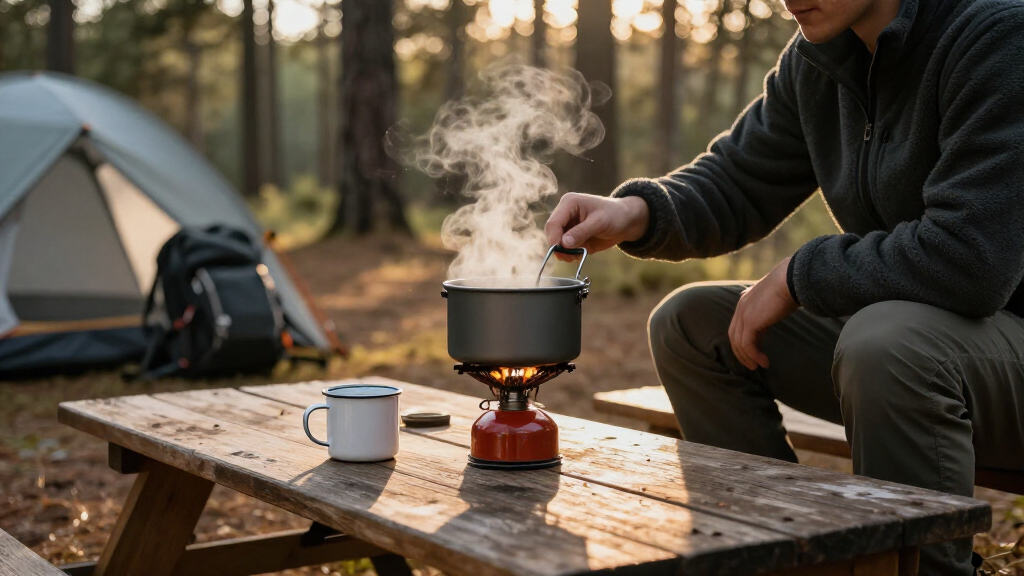
Portable camping stoves fall into five main types — canister, liquid fuel, alcohol, wood-burning, and solid fuel — and the right one depends on your trip style, the weather, and fuel availability where you’re going. Canister stoves boil a liter of water in 3–4 minutes and dominate backpacking, while liquid fuel stoves win in freezing temps and at altitude. Budget roughly 100g of canister fuel per person per day, and never cook inside a tent due to carbon monoxide risk.
Your camp stove is the difference between hot coffee at sunrise and a sad granola bar. It’s that simple. Yet walk into any outdoor shop and you’ll face a wall of options — tiny titanium burners, roaring multi-fuel beasts, little alcohol pots that weigh less than a deck of cards.
Here’s the good news: choosing comes down to three questions. How far are you carrying it? How cold is it where you’re going? And can you actually buy fuel there?
In this guide, you’ll learn the strengths and weaknesses of every major stove type, real numbers on boil times and fuel consumption, and the safety mistakes that send campers to the hospital every year. Let’s get you cooking.
Match the stove type to your trip: canister for general backpacking, liquid fuel for freezing temps and altitude, alcohol for ultralight, wood-burning only whe…
Budget ~100g of canister fuel per person per day for simple meals, plus a 25% buffer for wind and cold.
Most gas canisters use the EN 417 (Lindal) threaded valve, so brands like MSR, Jetboil, and Snow Peak are largely cross-compatible.
Never cook inside a tent or vehicle — carbon monoxide from camp stoves kills people every year. Fuel canisters are also banned from all flights.
Water boils at ~93°C at 3,000m altitude, so expect longer cook times in the mountains even with a good stove.
The 5 Types of Portable Stoves (And Who Each One Is For)
Portable camping stoves come in five main types: canister stoves that screw onto gas canisters, liquid fuel stoves that burn white gas or kerosene, ultralight alcohol stoves, wood-burning stoves that feed on twigs, and solid fuel tablet stoves for emergencies. Each one solves a different problem, and picking the wrong type is the most common mistake new campers make [1].
Think of it like choosing kitchen knives. A chef’s knife does most jobs well, but you wouldn’t fillet a fish with a bread knife. Same logic applies here — but to choose well, you need to understand the tradeoffs hiding inside each category, because every stove design sacrifices something to gain something else.
- Canister stoves — screw onto pressurized gas canisters (butane, isobutane, propane blends). Light, easy to use, boil water fast. The default choice for backpacking. What you give up: performance in freezing temperatures, and the ability to see how much fuel remains — a canister’s gauge is your ears and a kitchen scale. You also can’t fly with canisters or buy refills in every country, so trip planning matters.
- Liquid fuel stoves — burn white gas or kerosene from a refillable bottle. Heavier and fussier, but they keep burning when it’s -10°C outside. The tradeoff is maintenance and learning curve: you must pump, prime, and occasionally rebuild them, and a poorly primed stove produces a sooty flare-up. In exchange, you get a fuel you can pour, measure, and buy almost anywhere on Earth — which is why expedition and international travelers still swear by them.
- Alcohol stoves — a tiny pot with burning denatured alcohol. Nearly weightless and silent, but slow. Some weigh under 30 grams. The hidden tradeoff is energy density: alcohol carries roughly half the energy per gram of canister gas, so your ‘ultralight’ stove can mean heavier total fuel loads on longer trips. There’s also no flame adjustment — you’re boiling or you’re off — which is fine for freezer-bag meals and frustrating for anything else.
- Wood-burning stoves — twigs and sticks are the fuel, so you carry nothing. The catch is a triple one: fuel must be dry and available (rainy climates make these useless), fire bans often include them, and your boil time depends entirely on your fire-building skill. Where they shine is long trips through fuel-rich terrain, where carrying zero fuel compounds into serious weight savings.
- Solid fuel tablet stoves — hexamine tablets and a folding stand. Cheap, nearly indestructible, best as a backup. The implication of ‘backup’ is the whole point: tablets burn with a weak, unadjustable, faintly chemical-smelling flame that’s miserable as a primary stove but a lifesaver when your main stove fails or you need to sterilize water in an emergency.
Notice the pattern: weight, cold performance, and fuel logistics pull in opposite directions. No stove wins all three. A real example: my friend bought a fancy liquid fuel stove for a three-day summer trip, then spent twenty minutes every night priming it while his buddy’s canister stove had dinner ready in ten. Great stove, wrong trip. He paid the weight and complexity price for winter capability he never used — which is exactly the mistake matching your stove to your actual trips, not your fantasy ones, prevents.
Canister vs. Liquid Fuel vs. Alcohol: The Numbers That Matter
Canister stoves boil one liter of water in 3–4 minutes, integrated systems like Jetboil-style designs cut that to roughly 2 minutes thanks to heat exchangers, while alcohol stoves can take 6–8 minutes for the same job [1]. In freezing conditions, the tables turn — canister pressure drops and liquid fuel stoves take over.
Here’s how the big three stack up side by side:
| Feature | Canister | Liquid Fuel | Alcohol |
|---|---|---|---|
| Boil time (1L) | 3–4 min | 3–5 min | 6–8 min |
| Stove weight | 45–100g | 300–500g | 20–40g |
| Cold weather | Poor (unless regulated) | Excellent | Fair |
| Simmer control | Good to excellent | Good | Poor |
| Maintenance | None | Regular | None |
| Fuel availability | Widely sold, varies by country | Camping stores, some gas stations | Hardware stores, pharmacies |
Read the table with total trip weight in mind, not just stove weight. That 25g alcohol stove looks like the winner until you count fuel: because alcohol packs half the energy per gram of gas, a week of cooking can erase the weight advantage entirely. Conversely, a 400g liquid fuel stove seems heavy until you realize a single refillable bottle replaces a pile of canisters you’d otherwise carry out as trash. The right question isn’t ‘which stove is lightest?’ but ‘which system — stove plus fuel — is lightest for my trip length and conditions?’
One detail worth knowing: most canister stoves use the EN 417 threaded valve standard (the Lindal valve), so MSR, Jetboil, and Snow Peak canisters are largely cross-compatible [1]. That matters more than it sounds: it means a stove is a long-term investment while canisters are a commodity you can shop by price, and it means the only shop in a mountain village probably stocks fuel that fits your burner.
How Much Fuel to Pack (So You Never Run Out Mid-Trip)
Plan on roughly 100g of canister fuel per person per day for simple meals — boil-in-bag dinners, oatmeal, coffee [1]. That means a standard 230g canister covers two people for about two to three days of basic cooking.
Cooking from scratch? Double it. Frying, simmering sauces, and baking all burn through fuel far faster than boiling water. And cold weather pushes consumption up too, since you’re melting snow or fighting heat loss to the air.
- Count your cooking sessions — breakfast and dinner is typical; add lunch if you cook it.
- Multiply by people and days — 100g per person per day is your baseline.
- Add a 25% buffer — for wind, cold, and that one meal that goes wrong.
- Match canister size to the trip — 100g for a weekend solo, 230g for most trips, 450g for groups or base camps.
Why the 25% buffer matters: running out of fuel isn’t just an inconvenience — it can mean no safe drinking water if you’re treating water by boiling, and cold, uncooked food on a freezing night. Overdoing it has a cost too: every unused gram of fuel is weight you carried uphill for nothing. Fuel planning is really about buying margin where failure hurts most, not about perfect prediction.
Real scenario: two people, three days, hot breakfast and dinner only. That’s 600g of fuel — one 450g canister plus a 100g backup, or two 230s. Don’t carry a half-empty mystery canister; weigh it at home (a kitchen scale works) and label it. The payoff of that thirty seconds of weighing is starting every trip knowing exactly what’s in your pack instead of gambling on a canister’s slosh.
Winter and Altitude Change Everything — Here’s Why
Below freezing, standard canister stoves lose pressure and sputter to a weak flame, which is why winter campers either use regulated canister stoves, invert the canister upside down (remote designs allow this), or switch to liquid fuel [1]. At altitude, lower oxygen and air pressure mean water boils at about 93°C at 3,000 meters instead of 100°C — so pasta and rice take noticeably longer to cook.
The canister problem is basic physics. Butane stops vaporizing well around -0.5°C. Isobutane blends do better, down to roughly -12°C, and propane-blend canisters push further still — but the propane burns off first, leaving sluggish butane behind late in the canister’s life. This is why a stove that worked perfectly on night one can barely simmer by night four: the fuel’s composition literally changes as the canister empties, and it changes in the wrong direction for cold weather.
The altitude problem is sneakier because it doesn’t weaken your stove — it weakens your cooking. Water boiling at 93°C is 7 degrees cooler than your recipes assume, so anything that needs actual cooking (rice, pasta, dried beans) takes dramatically longer, burning more fuel, while things that need sterilization still work fine since 93°C is well above pasteurization temperatures. The implication: at altitude, choose meals that only need hot water rather than real cooking, and you sidestep the problem entirely.
I watched a group in the Alps try to make coffee at -8°C with a bargain-basement butane stove. The flame came out the size of a birthday candle. Their neighbor’s inverted-canister setup was roaring. Same fuel chemistry, completely different morning. The difference wasn’t money — it was understanding the physics.
The fix is simple: for trips below freezing or above 3,000 meters, bring a regulated stove or a liquid fuel model, and keep your canister warm — tucked in your sleeping bag overnight works, but never warm it over a flame.
Safety Mistakes That Actually Kill People Every Year
The single most dangerous thing you can do with a portable camping stove is light it inside a tent, vehicle, or any enclosed space — carbon monoxide poisoning from camp stoves causes deaths every single year [1]. Cook outside, in the open, every time. No exceptions, not even in a storm.
Never use a camping stove inside a tent, vehicle, or enclosed space. Carbon monoxide is odorless, and victims lose consciousness before they realize anything is wrong.
Understanding why this kills makes the rule stick. Carbon monoxide binds to hemoglobin roughly 200 times more strongly than oxygen, so a small exposure progressively locks your blood’s oxygen-carrying capacity — and in a sealed tent’s still air, a stove’s flame consumes oxygen while producing CO, creating a double trap. The deadly part is that early symptoms (headache, drowsiness) feel like ordinary camping fatigue, which is exactly why people underestimate it until they can’t act. A tent’s porch or vestibule is not ‘outside enough’ — any surface traps the gas near your sleeping body.
- Flying? You can take a clean, empty stove on a plane, but fuel canisters are banned from both checked and carry-on bags. The logic: pressurized containers in unpressurized cargo holds are a rupture risk, and residual fuel vapors are flammable. Buy fuel at your destination [1].
- Fire bans: Check restrictions before every trip, especially in the western US and Australia. Wood-burning stoves often count under total fire bans — the risk regulators care about is escaping embers, not just open flames — and even alcohol stoves are prohibited in some US national parks during fire season [1].
- Storage: Keep canisters away from heat and direct sun. Never toss a pressurized canister into a fire — heating a sealed pressure vessel has only one outcome, and it’s explosive.
- Disposal: Puncture tools exist for emptying canisters before recycling, but local rules vary widely — a canister with residual gas is both a recycling hazard and a landfill risk.
A two-minute check of current fire regulations before you leave beats a hefty fine — or worse, a wildfire.
Cooking Real Meals, Not Just Boiling Water
If you only boil water for freeze-dried meals, almost any stove works. But if you actually want to fry eggs, simmer chili, or make pancakes, you need simmer control — and that’s where cheap canister stoves fall apart, jumping from full blast to nothing with a hair’s turn of the valve [1].
Why this happens is worth understanding: cheap stoves use a simple needle valve with a tiny adjustment range, so the difference between ‘off’ and ‘inferno’ is a few degrees of twist. Better stoves add finer thread pitch or regulator valves that decouple flame size from canister pressure — which is also why they simmer consistently from a full canister to a nearly empty one. The practical implication: if you cook rather than boil, valve quality matters more than stove weight or boil time, the two specs everyone obsesses over.
Integrated systems like the Jetboil style boil brilliantly but cook poorly — the narrow pots and focused flames scorch anything thick. The physics is simple: concentrating heat in a small ring at the pot’s base works great for water (which convects and self-mixes) and terribly for chili (which sits and burns exactly where the flame hits). For real cooking, look for a stove with a wide, adjustable flame and decent pot supports.
Practical setup for a cook-camp: bring an integrated system for fast water boiling plus a small canister stove with good simmer control for the pan work. It sounds like overkill until you’re flipping pancakes while coffee water heats — and since both share the same canister thread, the extra cost is one burner, not a second fuel system.
Also consider wind resistance. A breeze can double your boil time and burn through fuel — wind strips heat away from the pot’s sides faster than the flame can replace it, so you’re paying full fuel cost for a fraction of the cooking power. Integrated systems have built-in windscreens; open burners need a folding windscreen (placed around, never over, a canister stove to avoid overheating the canister — a wrapped canister is a pressure bomb warming on your own burner).
What’s Trending (And What’s Worth Your Money)
The backpacking market is currently dominated by integrated stove systems with heat exchangers, while ultralight titanium builds have pushed standalone stove weights below 45 grams [1]. Other trends worth knowing: regulated canister stoves that maintain output as pressure drops, remote-canister designs for cold-weather inverted use, and growing interest in wood-burning stoves tied to leave-no-trace philosophies.
There’s also a sustainability pushback. Single-use canisters pile up at trailheads, and recycled and refillable canister programs are starting to appear in Europe and North America [1].
My spending advice: put your money where your cooking style is. A $25 basic canister stove handles 90% of trips fine. Splurge on an integrated system only if you boil water constantly, and on liquid fuel only if you camp in real winter. Skip gimmicks — titanium everything looks great on Instagram but the weight savings rarely justify triple the price for weekend campers.
The best stove is the one whose fuel you can actually buy within walking distance of your campsite.
Frequently Asked Questions
Can I take a camping stove on a plane?
Yes, if it’s clean and completely empty of fuel — airlines and TSA allow stoves in checked or carry-on bags. Fuel canisters, however, are banned entirely, whether checked or carried on. The practical move is flying with the stove only and buying fuel at your destination [1].
How long does a 230g gas canister last?
Roughly two to three days for two people cooking simple meals, based on the ~100g-per-person-per-day rule of thumb [1]. Cold weather, wind, and cooking from scratch will drain it faster. For a solo weekend, a 100g canister is usually enough.
Are butane canisters safe, or can they explode?
They’re safe when used as intended: upright, outdoors, away from heat sources. Canisters explode when overheated — never use a full wraparound windscreen on a canister stove, never dispose of canisters in a fire, and store them out of hot cars and direct sun [1].
Why won’t my canister stove light or keep a flame?
The most common causes are a cold canister (below freezing, butane stops vaporizing), a partially empty canister, or a clogged jet. Warm the canister inside your jacket first, weigh it to check fuel level, and clean the jet with the tool most stoves ship with. If the flame weakens as the canister empties in cold weather, try inverting it with a remote-canister design [1].
Which portable stove is best for car camping vs. backpacking?
For car camping, weight doesn’t matter — get a double-burner propane stove with good simmer control for real cooking. For backpacking, a canister stove under 100g (or an integrated system if you mostly boil water) is the standard choice [1].
Conclusion
Before you buy, answer three questions honestly: How far am I carrying this? How cold will it get? Can I buy fuel there? The answers point to one stove type every time — and for most campers, that answer is a simple canister stove with a spare 230g canister. Verify current fire bans and airline rules before every trip, since regulations change frequently.
Because at the end of the day, the right stove isn’t the one with the best specs. It’s the one quietly boiling water while you watch the sun drop behind the ridge, dinner ten minutes from done.
Halloween Picks
halloween
As an affiliate, we earn on qualifying purchases.